
I Never Considered I Would Need a Walker
By Karen L. Rancourt
As an active and healthy 81-year-old, I never considered that I would need a walker, but there I was.
As I have since learned, a walker is a type of “mobility aid” or “walking aid.” The four most common types of these aids are: wheelchairs; mobility scooters; walkers & rollator walkers; and canes & crutches.
I had a rollator walker. The main difference between a walker and a rollator walker is that a walker has four legs that need to be lifted while moving, while a rollator walker has wheels that allow the user to push it forward.
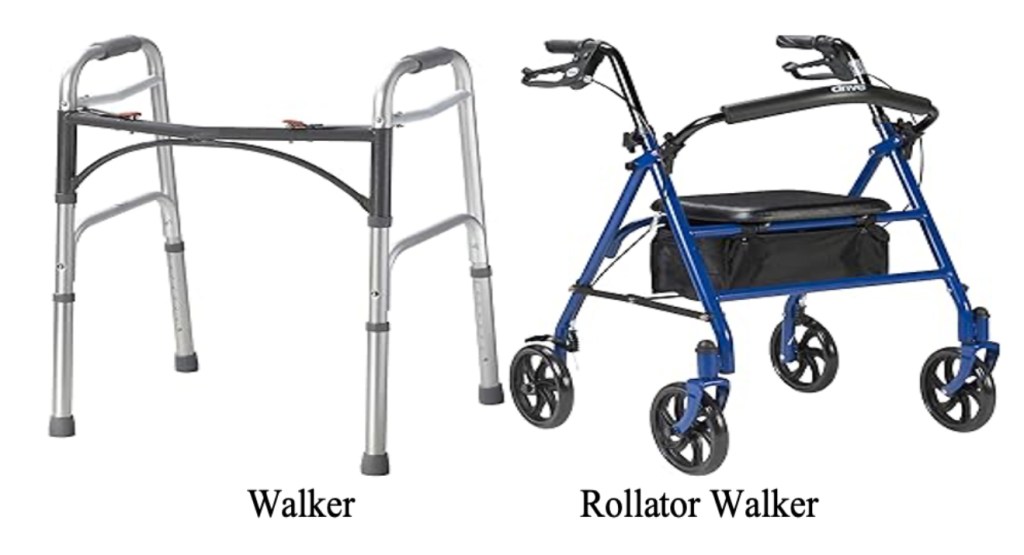
I will explain how I came to need my rollator walker, but first, some information about walking aids and the market: (1), (2).
About 6.8 million Americans use one or more walking aid devices. For example, at first, I was using crutches and a cane, then I used a cane and a rollator walker, as well as a knee brace.
– 5,788,000 use a cane
– 4,094,000 us a walker or rollator
– 2,135,000 use a wheelchair
– 815,000 use a mobilized scooter
As it turns out, these numbers do not include the many people who could benefit from using a walking aid, but don’t, because of the potential stigma of being perceived as old (the implication that being old is a negative), disabled, or less cognitively with it. This reluctance to use a walking device is unfortunate, because it is estimated that 35-40% of adults living in their own homes, age 65 and older, fall each year (1).
Walking aids are often recommended for the following conditions:
- Disability, chronic conditions, or age.
- Recovery from surgery or an injury.
- A history of falls or a fear of falling.
- Difficulty climbing stairs or walking on uneven surfaces.
- Deteriorating balance.
- Pain, weakness, or instability in any part of your leg.
- Slippery weather.
My Story
When my right knee started to ache, I did a common and regrettable thing: I ignored it and kept on with my usual stretches, strength training, and various exercises, e.g., biking, walking, paddle boarding, water walking. Big mistake. The problem in my knee progressed to the point where I could not walk because of the pain.
An X-ray, followed by an MRI (magnetic resonance imaging), indicated that I had three things going on: (1) a moderate level of degenerative joint disease (DJD) or osteoarthritis, meaning there is noticeable cartilage damage and joint space narrowing. This is a normal part of aging, no biggie; (2) torn meniscus at the root, that is, where it connects to the tibia bone, potential biggie; (3) stress fracture of the tibia, probably caused by the torn meniscus, definitely a biggie.
Meniscus tears are a common knee injury affecting around a million people in the United States each year, mostly athletes and senior citizens, with studies showing that 60% of people over 65 have some form of degenerative meniscus tear. For detailed information on meniscus tears and how to improve meniscus health, (1), (2).
In my case, I was looking at six weeks to three months for what we hoped would be an adequate recovery of the tibia stress fracture and that the permanent meniscus tear would not compromise my quality of life. This meant putting no direct weight on my right knee, hence my use of a cane, rollator walker, and knee brace.
All three devices gave me some mobility and independence: I became quite proficient by leaning on walls and counters and balancing on one foot to do the regular chores I enjoy doing, such as, cooking, doing laundry, putting groceries away.
And with a nod of gratitude to Gary, my husband of 59 years, who, when I was incapacitated, uncomplainingly waited on me and did all my chores, as well as his own.
My Plan Going Forward
I was highly motivated to get my knee back to its best condition possible for several reasons:
- For his upcoming 80th birthday, Gary has planned a wonderful trip to Italy for us, a trip that will require lots of walking.
- I value my independence, and I want to have as much of it as possible.
- I missed my daily stretches, strength training, and exercise when I was immobile. This knee challenge has made me realize that I need to change what I was doing if I want to find the right balance between staying fit and active and being kind to my aging body.
This balance requires that I do less of those activities that can exacerbate joint and muscle weaknesses, e.g., deep knee bends, lunges, spinal twists. It also means I shorten my workout times. More is not always better.
One important resource I have found gets me off my feet and lets me do upper and lower body exercises, weight training, and yoga, all from a chair. Even now that I am back to a regular regimen, I continue to do these exercises from a chair. They are kinder to the body, and they get the job done.
I highly recommend these chair exercises to everyone – those who are new to working out, as well as those who are more experienced. All the videos are facilitated by Lauren, who is warm and encouraging.
- Here is a complete list of all of Lauren’s Senior Shape Fitness workout videos.
Update
After three months of following the daily regimen set out by a physical therapist and by following my orthopedic surgeon’s instructions – that is, strength and stretching exercises and physical activities I could and could not do, e.g., pool walking yes, but no biking and standup paddle boarding until my tibia stress fracture was fully healed – I could now safely resume all activities and exercises. It’s good to be back!
 Karen L. Rancourt